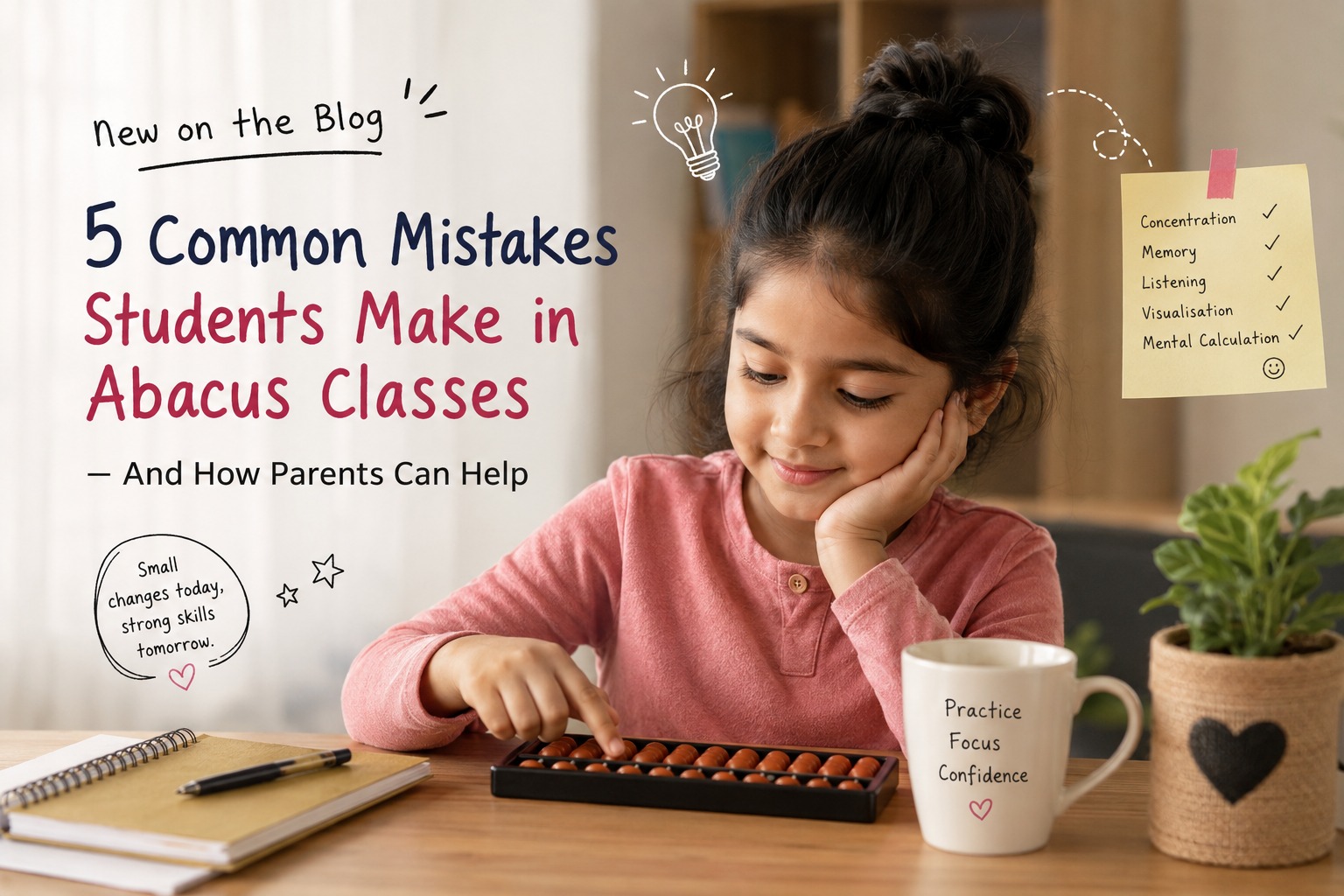
When a child joins an abacus class, parents often look forward to seeing them calculate faster and perform better in maths. But learning abacus is about much more than getting answers quickly. It is a skill that develops with practice, patience and active participation.
The UCMAS programme is designed to help children develop skills such as concentration, memory, listening, visualisation and mental calculation. However, like with any new skill, children can sometimes develop habits that slow down their progress.
Here are five common mistakes students make in abacus classes and what parents can do to help.
1. Thinking of Abacus as Just Another Tuition Class
Some children attend their abacus class, complete the work given by the teacher and then forget about it until the next class. But abacus learning works differently from simply studying a school subject.
Children need to actively use the abacus, listen carefully, visualise numbers and gradually learn to calculate mentally. The more actively they participate, the better they are likely to develop these skills.
What parents can do: Ask your child about what they learned in class. You could even ask them to demonstrate a few simple calculations or explain something they found interesting.
2. Skipping Practice at Home
This is probably one of the most common challenges. A child may enjoy their UCMAS abacus classes, but if practice stops as soon as they leave the classroom, progress can become slower.
Abacus is a skill, and skills become stronger with regular practice. It does not necessarily have to mean spending a long time every day. A few minutes of focused practice can be much more useful than doing a lot of work only before a test.
What parents can do: Try to make practice a simple part of the daily routine rather than treating it like a punishment or extra homework.
3. Trying to Be Faster Than Everyone Else
Children naturally enjoy seeing how quickly they can calculate. Speed is one of the exciting outcomes of mental arithmetic, but there is a difference between being fast and rushing.
When children focus too much on speed, they may start making avoidable mistakes. Over time, this can affect both accuracy and confidence.
What parents can do: Remind your child that getting the answer right is more important than being the first one to finish. Speed will come naturally with regular practice.
4. Comparing Their Progress With Other Children
Every child has their own learning pace. One child may quickly become comfortable with mental calculation, while another may need more time and repetition.
Comparing marks, levels or calculation speed with another child can sometimes make learning feel like a competition they are constantly losing.
What parents can do: Compare your child's progress with their own previous performance. If they are making fewer mistakes, concentrating better or becoming more confident, that is progress worth celebrating.
5. Limiting Practice to the Workbook
Some students think that completing the questions in their abacus book is all the practice they need. While book practice is important, children can benefit from practising in different ways.
Abacus learning involves more than solving written calculations. Skills such as visualisation, listening, concentration, speed and accuracy also need regular practice. This is where additional practice resources and activities can be useful.
The UCMAS programme provides supplementary software applications that students can use at no additional cost. These activities give children opportunities to practise visual and listening-based exercises beyond their regular workbook.
Students can also benefit from participating in abacus competitions. Working against the clock and solving questions in a competitive environment can encourage children to improve their speed and accuracy while building confidence and focus.
What parents can do: Encourage your child to make use of the additional UCMAS practice resources and participate in competitions when opportunities are available. A combination of regular bookwork, digital practice and competition experience can make practice more varied and engaging.
Helping Your Child Get the Most From UCMAS
The best results from the UCMAS programme do not come from simply attending classes. They come from a combination of regular practice, active participation, patience and encouragement.
As parents, you do not need to become an abacus teacher at home. Your role can be much simpler: encourage your child, appreciate their effort and give them the confidence to keep trying.
And remember, progress is not always about how many calculations a child can complete in a minute. Sometimes it is a child who is concentrating for longer, making fewer mistakes, answering with more confidence or simply saying, "I can do this!"
Those small changes are often the signs that learning is really happening.
Frequently Asked Questions
How much should my child practise at home after abacus classes?
Regular, short practice is usually more effective than long practice sessions once in a while. A minimum of 15-20 minute practice everyday would be ideal. Following the practice routine recommended by the UCMAS centre and using the available supplementary resources can help children build consistency.
Can parents help with abacus practice at home?
Absolutely. Parents do not need to teach the abacus programme themselves at home. Encouraging regular practice and motivating children to use the available UCMAS practice resources can go a long way in supporting their learning journey.
Are UCMAS competitions useful for children?
Yes. Competitions give children an opportunity to practise calculations in a timed and motivating environment. Participating regularly can help them work on speed, accuracy, concentration and confidence while making the learning experience more exciting.