A few years ago, parents worried about whether their children should learn computers. Today, calculators are built into every smartphone, and artificial intelligence can solve complex mathematical problems in seconds. Naturally, many parents ask:
Is learning on abacus still worth today?
It is a fair question. If technology can calculate faster than any human, why should children spend years learning mental arithmetic?
The answer lies in understanding the true purpose of an UCMAS abacus programme. Contrary to popular belief, it was never designed to compete with calculators or replace technology. Its primary objective is to develop a child's cognitive abilities during the years when the brain is growing the fastest. Once parents understand this distinction, they realise that the relevance of abacus has not reduced. In many ways, it has become even more significant.
The Purpose of an Abacus Programme Has Evolved
Years ago, fast calculation was seen as one of the biggest advantages of learning abacus. While mental arithmetic is still an impressive skill, the focus of modern UCMAS Abacus Classes has shifted beyond numbers.
Today abacus classes focus on is on developing concentration, memory, visualization, listening skills, observation, confidence, and the ability to process information quickly. These are foundational skills that support learning across subjects, whether it is mathematics, science, languages, or even public speaking.
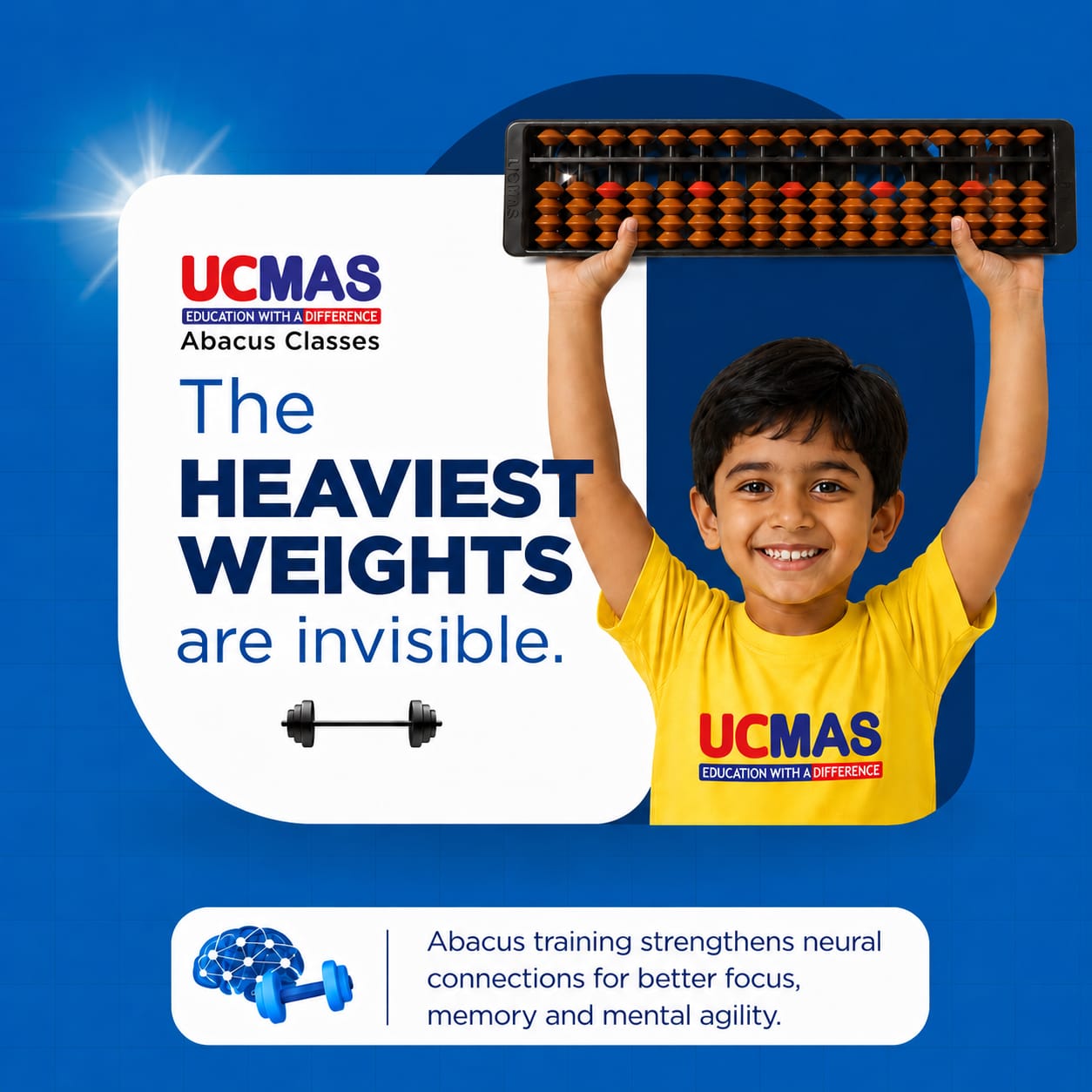
The abacus simply serves as a tool to exercise the brain. Just as physical exercise strengthens muscles, structured mental practice strengthens cognitive abilities. The calculations are not the end goal. They are the method through which the brain is trained.
👉To understand how the Abacus Programme works, explore programme structure here.
Technology Can Provide Answers. It Cannot Develop Thinking.
The world our children are growing up in is vastly different from the one we experienced. Artificial intelligence can explain concepts, solve equations, write essays, and answer questions almost instantly. Calculators have eliminated the need for manual calculations in everyday life.
However, while technology has become smarter, children's brains still develop in the same way they always have. Concentration, memory, logical thinking, creativity, and confidence cannot be downloaded from an app. These abilities are developed through repeated practice and meaningful learning experiences.
The UCMAS Abacus Programme encourages children to think actively instead of depending on external tools for every answer. Rather than simply producing results, it strengthens the mental processes involved in understanding, analysing, and solving problems.
As AI becomes a part of everyday life, it rewards people who know how to ask better questions, analyse information critically, and make sound decisions. These are human abilities that technology cannot develop on its own.
Why Brain Development Matters More Than Ever
The future belongs to children who can think independently.
As AI becomes a part of education and everyday life, knowledge alone will no longer be enough. Information is available to everyone within seconds. What will distinguish one child from another is not how quickly they can search for an answer, but how effectively they can understand it, evaluate it, and apply it.
Skills such as sustained concentration, strong memory, mental discipline, problem-solving, and confidence are becoming increasingly valuable. These qualities influence academic performance, communication, decision-making, and even leadership later in life.
An abacus programme nurtures many of these abilities during early childhood, when the brain is naturally more adaptable and receptive to learning.
It Is About More Than Mathematics
One of the biggest misconceptions about abacus is that it is only useful for improving mathematics.
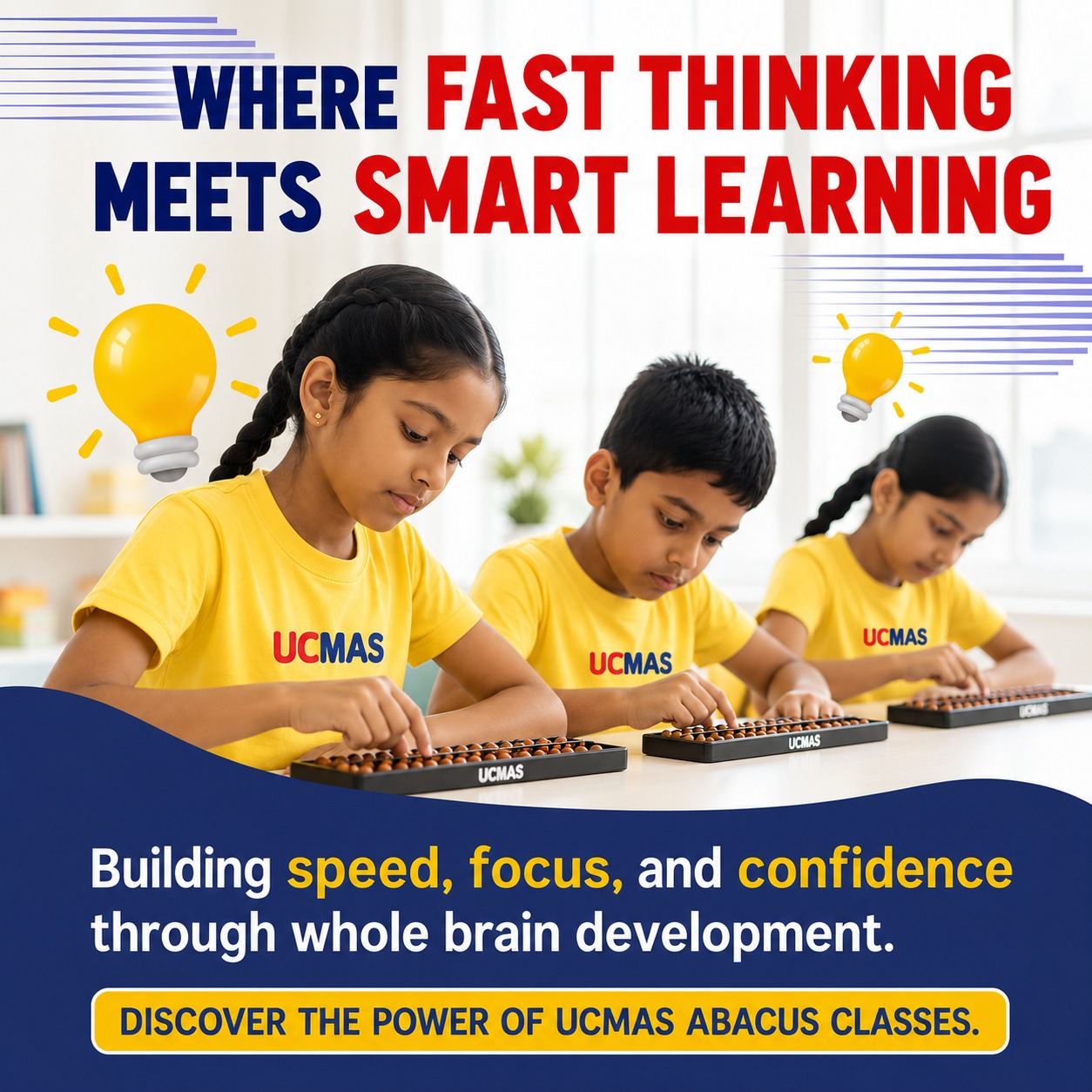
In reality, parents often notice improvements that extend well beyond calculations. Children become more attentive in the classroom, remember instructions more easily, complete homework with greater focus, and approach new challenges with increased confidence. These changes occur because the programme develops the underlying mental skills that support learning itself.
A child with better concentration is likely to perform better while reading a chapter, listening to a teacher, learning a new language, or preparing for an examination. Likewise, stronger memory and improved focus benefit every subject, not just mathematics.This is why many educators describe UCMAS abacus classes as a brain development programme for children rather than simply a maths programme.
The Right Age Makes a Difference
Childhood is one of the most important stages of brain development. During these years, children absorb information rapidly and develop habits that often stay with them for life.
Abacus training takes advantage of this learning phase by gradually moving children from using a physical abacus to visualising it mentally. This progression encourages them to imagine, concentrate, and calculate at the same time. As they advance, they rely less on physical movement and more on mental imagery, strengthening both logical thinking and visualization.The earlier these cognitive abilities are developed, the more naturally they support future learning.
Is Abacus Relevant in the AI Era?
Some people believe that because artificial intelligence can solve almost any mathematical problem, learning mental calculation has become unnecessary.
Ironically, the opposite may be true.
As technology becomes more capable, human skills become more valuable. Children who can concentrate deeply, think critically, learn independently, and remain confident while solving problems will always have an advantage over those who depend entirely on technology.
Artificial intelligence is an excellent tool, but it should complement human intelligence, not replace its development. Children who build strong cognitive foundations early are better prepared to use technology effectively rather than becoming overly dependent on it.
Should Every Child Learn Abacus?
Abacus is not designed only for children who enjoy mathematics or aspire to become mathematicians. It is intended for children during their formative years, when their brains are developing rapidly and are most responsive to structured learning experiences.
Every child develops differently, and no programme can guarantee identical outcomes. However, regular practice, guided instruction, and consistent encouragement can help children strengthen important mental abilities that support both academics and everyday life.
For parents, the question is no longer whether children need another way to calculate. The more important question is whether they are developing the skills needed to think, learn, and adapt in an increasingly technology-driven world.
👉 Explore why thousands of parents choose UCMAS abacus programme for their children
Final Thoughts
So, is the abacus programme still relevant today?
Absolutely!
Not because calculators have disappeared or artificial intelligence cannot solve mathematics. It remains relevant because its purpose has always been much broader than calculation. An abacus programme develops concentration, memory, visualization, confidence, and disciplined thinking during the years when these abilities can have the greatest long-term impact.
Technology will continue to evolve, and children should certainly learn to use it. But alongside digital skills, they also need strong cognitive foundations that help them analyse information, solve problems independently, and approach challenges with confidence.
In the end, technology may provide the answers, but it is the human mind that determines how those answers are understood, evaluated, and applied. That is precisely why the UCMAS abacus programme continues to remain relevant - not just today, but for many years to come.